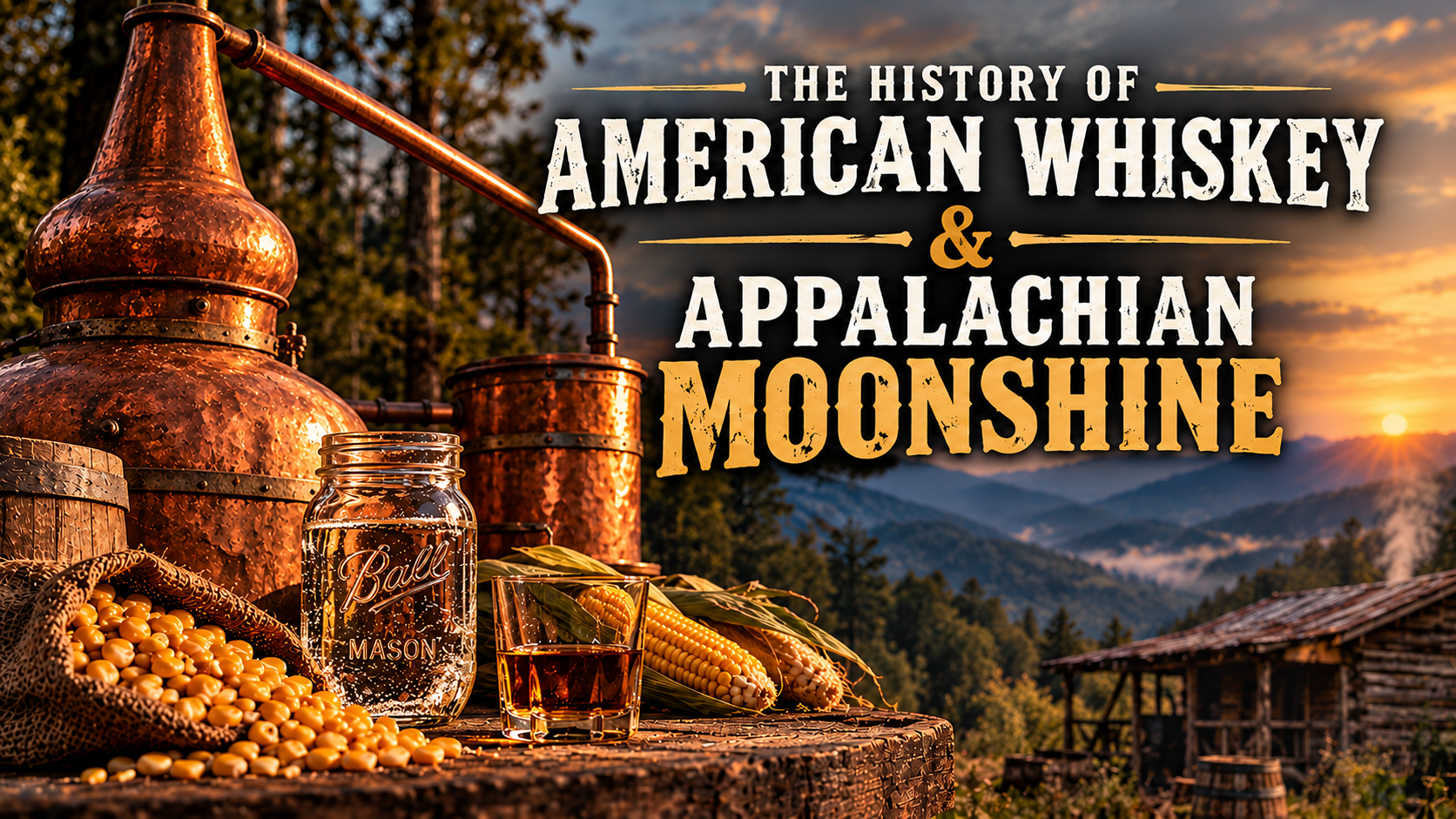
From Frontier Whiskey to Appalachian Moonshine: The American Tradition That Still Lives On
How early American settlers, Appalachian moonshiners, and generations of copper still builders helped shape the whiskey-making traditions that hobby distillers are rediscovering today.
Long before whiskey came in fancy bottles with expensive labels, it was being made in cabins, barns, and small farm distilleries scattered across the American frontier.
There were no computers controlling temperatures, no digital proofing instruments, and certainly no instruction manuals from the internet. Just locally grown grain, water, yeast, fire, copper, and knowledge passed down from one generation to the next.
For many early Americans, making whiskey wasn’t simply about producing something to drink. It was a way to preserve the value of their harvest, support their families, and turn the crops they worked so hard to grow into something they could sell or trade.
As America expanded westward, whiskey traveled with it. Over time, the traditions of frontier distilling helped shape what would become one of the most recognizable pieces of Appalachian culture: moonshine.
Today, those same traditions continue to capture the interest of hobby distilling enthusiasts across the country.
But to understand why so many people are drawn to traditional copper pot stills, old-fashioned corn whiskey, and the art of distilling, we need to go back to where it all started.
Whiskey on the American Frontier: More Than Just a Drink
During the 1700s and early 1800s, settlers moving into Pennsylvania, Virginia, Kentucky, Tennessee, and the Appalachian backcountry faced challenges that are difficult to imagine today.
Roads were poor, transportation was expensive, and markets were often many miles away.
A farmer might grow hundreds of bushels of corn or rye, but transporting that grain across the mountains to sell it wasn’t always practical.
Whiskey provided a solution.
By converting grain into distilled spirits, farmers could create a product that was easier to transport, less perishable, and often considerably more valuable than the original crop.
A few containers of whiskey were much easier to carry over rough mountain trails than wagonloads of grain.
Whiskey could be sold, traded, or used as a form of payment when cash was scarce.
In fact, the National Park Service documents how distilling became an important part of early American agriculture, with corn and rye commonly converted into whiskey for local consumption and trade.
For the frontier farmer, a whiskey still was more than a piece of equipment. It was another tool for making a living.
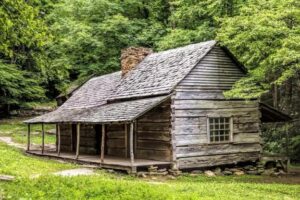
What did early American whiskey taste like?
Frontier whiskey was often quite different from the aged bourbon and rye whiskey we recognize today.
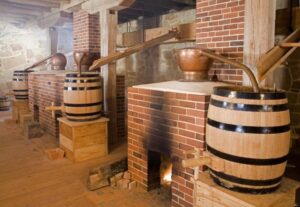
Much of it was produced in simple pot stills and consumed relatively young, sometimes without any barrel aging at all.
Depending on the region, whiskey could be made from corn, rye, wheat, barley, or combinations of available grains.
These early spirits often retained strong grain character because traditional pot still distillation allowed many of the flavors created during fermentation to carry into the finished product.
The process wasn’t necessarily about creating the cleanest or highest-proof alcohol possible.
It was about making whiskey from the ingredients farmers had available.
And as the American frontier expanded, corn would become increasingly important to that tradition.
How Corn Became the Backbone of American Whiskey
Corn wasn’t introduced to North America by European settlers. Indigenous peoples had cultivated and developed maize for thousands of years before European colonization.
As settlers moved into the American interior, they adopted corn as one of their most important crops.
It grew well in many regions, produced useful yields, and could feed families and livestock.
It also made an excellent foundation for whiskey.
Corn-based whiskey developed into an important tradition throughout Kentucky, Tennessee, and the Southern Appalachian Mountains.
Unlike rye, which can produce a spicy, peppery character, corn tends to contribute to a sweeter, fuller grain flavor.
When distilled using a traditional pot still, corn-based spirits can retain distinctive characteristics from the grain and fermentation.
Even today, whiskey enthusiasts continue to experiment with traditional and heirloom varieties such as Hickory King, Bloody Butcher, and Jimmy Red corn.
Different varieties can contribute to different flavors, although fermentation methods, grain preparation, and distillation choices also have an enormous influence on the final spirit.
That is one of the fascinating things about traditional American whiskey.
The grain matters, the still matters, and the person operating the still matters.
No two distillers necessarily produce the same result, even when starting with similar ingredients.
The Whiskey Rebellion: When Making Whiskey Became a Political Fight
By the late 1700s, whiskey was so important to the frontier economy that the federal government recognized it as a potential source of tax revenue.
In 1791, Congress established a federal excise tax on distilled spirits.
For smaller frontier producers, the tax created considerable resentment.
Many believed the system unfairly favored larger commercial distilleries and placed additional financial pressure on rural farmers who relied on whiskey production.
Opposition was particularly intense in western Pennsylvania.
The dispute eventually escalated into what became known as the Whiskey Rebellion of 1794.
President George Washington mobilized militia forces to enforce federal authority and bring the resistance under control.
The rebellion became an important test of the young federal government’s ability to enforce its laws.
But the larger disagreement between small rural distillers and federal taxation did not simply disappear.
Over the following century, changing liquor taxes, regulations, and enforcement practices would help push some distilling operations underground.
And in the mountains of Appalachia, that underground tradition developed a culture of its own.
The Birth of Appalachian Moonshine
The Appalachian Mountains provided the perfect setting for small-scale whiskey production.
Rural communities were often isolated, families commonly relied on what they could grow or make themselves, and traditional skills remained valuable from one generation to the next.
Many European settlers brought experience with brewing and distilling from Scotland, Ireland, Germany, and elsewhere.
They adapted those techniques to American crops, equipment, and conditions.
Corn whiskey became particularly important throughout the Southern Appalachians.
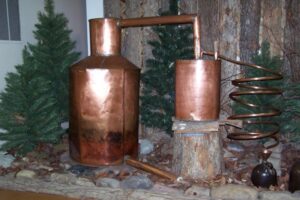
A typical mountain distilling operation might use a handmade copper pot still, a simple condenser known as a worm, wooden fermentation barrels, and water supplied by a nearby spring.
Some operations were small and primarily supported the household or local community. Others developed into substantial businesses.
The National Park Service describes Appalachian moonshining as a continuation of older agricultural practices that allowed mountain families to turn their corn into a valuable commodity.
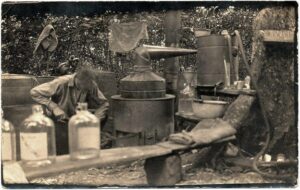
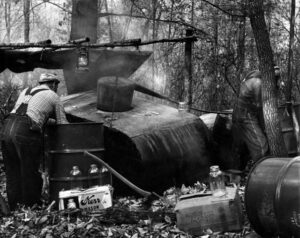
Why was it called moonshine?
The term moonshine became associated with spirits produced illegally or without payment of required taxes.
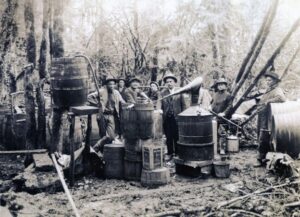
Because illegal still operators wanted to avoid detection, equipment was sometimes hidden in remote hollows, wooded areas, and mountain valleys.
Some distillers worked at night to avoid attracting attention, helping reinforce the association with moonlight.
However, not every moonshiner worked exclusively at night, and not every mountain whiskey maker operated illegally.
The distinction is important.
Making whiskey was an established American agricultural practice long before the period most people associate with moonshining.
It was taxation and legal restrictions, rather than a completely different method of distillation, that increasingly separated legal whiskey producers from illegal moonshiners.
Copper Stills and the Ingenuity of Mountain Distillers
One of the most recognizable pieces of Appalachian moonshining history is the traditional copper still.
The basic concept was relatively straightforward.
A copper pot held the fermented mash or wash. Heat generated vapor, which traveled through a cap or neck and into a condenser where it was cooled back into liquid.
Mountain distillers developed numerous variations on this design.
Some used simple pot-and-worm configurations. Others incorporated additional vessels, including thumpers, to change how the spirit was distilled.
Still sizes and shapes varied according to available materials, desired production volume, and the builder’s knowledge.
Why did copper become so popular?
Copper offered several practical advantages.
It transfers heat effectively, can be formed into curved shapes, and can be joined and repaired by skilled metalworkers.
Copper also reacts with certain sulfur-containing compounds created during fermentation, helping reduce some undesirable aromas in the finished spirit.
This combination of workable material and useful distilling properties helped make copper an enduring part of the American whiskey tradition.
But the real ingenuity often came from the person building the equipment.
Early still makers rarely had access to the specialized tools and modern fabrication technology available today.
Many formed components by hand, joined copper with traditional techniques, and built equipment around whatever materials they could obtain.
A skilled builder might produce a still that operated for years, sometimes passing it down through the family.
That tradition of craftsmanship is an important connection between historical moonshining and today’s American copper still builders.
Modern fabrication techniques may be different, but the underlying principles of copper pot still design remain remarkably familiar.
Prohibition: When Moonshining Became Big Business
In 1920, the United States entered the Prohibition era.
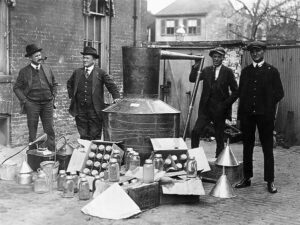
The 18th Amendment and the Volstead Act prohibited the manufacture, sale, and transportation of alcoholic beverages for most purposes.
But Americans didn’t suddenly stop drinking whiskey.
Instead, an enormous underground market developed for illegally produced and transported spirits.
Appalachian moonshiners were already familiar with operating outside government tax regulations, and demand for their product created new opportunities.
What had often been a small agricultural enterprise could now become a lucrative commercial operation.
Some distillers expanded production, built larger stills, and developed networks of people willing to transport whiskey to customers.
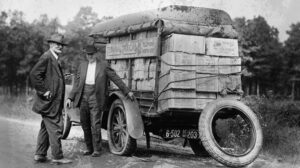
Those transporting illegal whiskey became known as bootleggers or whiskey runners.
Many modified their vehicles to carry heavy loads while maintaining enough speed to escape law enforcement.
These drivers eventually helped shape another uniquely American tradition: stock car racing.
Some early NASCAR drivers, team owners, and mechanics had direct connections to the illegal whiskey trade, especially in the Southeast.
When Prohibition ended on December 5, 1933, moonshining didn’t disappear.
Federal liquor taxes remained, some communities continued to prohibit alcohol sales, and illegal distillers could still make money by avoiding taxes and licensing requirements.
For decades afterward, the image of copper stills hidden in mountain hollows remained closely associated with Appalachia.
Separating Moonshine History From Moonshine Myths
Over the years, moonshine has become surrounded by stories, legends, and misconceptions.
Some are based on genuine historical practices. Others have been exaggerated through movies, television, and storytelling.
One of the biggest misconceptions is that traditional moonshine was always extremely high-proof alcohol with little flavor.
In reality, different distillers produced different styles of spirits.
Some made traditional corn whiskey, while others produced sugar-based spirits or mixtures of grain and sugar.
The proof, flavor, and quality depended on the ingredients, fermentation, equipment, and skill of the person operating the still.
Another misconception is that all old-fashioned moonshine was exceptionally good.
Just like today, some distillers were highly skilled while others produced poor-quality or unsafe products.
Improvised materials, contaminated equipment, and improper production practices sometimes created serious health hazards.
And contrary to popular belief, a high proof reading, flame test, or jar shake cannot establish that a spirit is safe to drink.
The real lesson from traditional moonshining isn’t that old-fashioned methods were automatically better. It’s that knowledge, experience, and attention to detail have always mattered.
From Mountain Hollows to Modern Distilling Equipment:
Fast-forward to today, and interest in traditional American whiskey-making remains strong.
Modern enthusiasts are researching historic mash bills, exploring heirloom corn varieties, studying fermentation, and learning how different still designs influence whiskey production.
Some are fascinated by the chemistry. Others enjoy the craftsmanship of copper equipment or the agricultural history behind traditional spirits.
Many simply appreciate the idea of learning a skill that connects them to previous generations.
However, today’s hobby distilling community has access to something early frontier distillers could hardly imagine: an enormous amount of technical information.
Modern distilling education explains how fermentation temperatures, yeast health, grain selection, vapor behavior, and condenser design influence spirit production.
Equipment has also changed considerably.
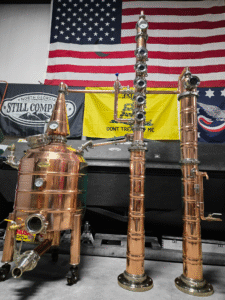
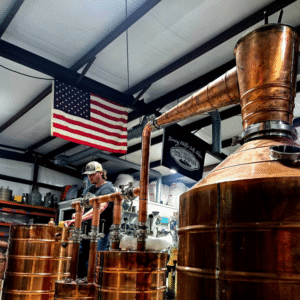
Today’s copper still builders can combine traditional designs with TIG welding, stainless steel fittings, precision fabrication, and improved instrumentation.
The result is equipment that preserves the appearance and operating principles of historic copper pot stills while incorporating modern features.
The principles haven’t changed
Despite all these advances, several important aspects of traditional whiskey-making remain just as relevant today.
- Grain selection: Corn, rye, wheat, and barley still provide the foundation for different American whiskey styles.
- Fermentation: Yeast, temperature, and fermentation conditions influence which aromas and flavors develop before distillation.
- Still design: Pot shape, vapor path, copper contact, and natural reflux influence how a still behaves and the character of the resulting spirit.
- Distiller knowledge: Understanding equipment and recognizing changes during production remain important skills.
- Craftsmanship: Properly designed, well-built equipment contributes to consistent operation and long-term reliability.
Modern equipment can make many parts of the process more convenient, but it doesn’t eliminate the importance of understanding what’s happening inside the still.
An expensive piece of equipment cannot replace good fundamentals.
And a simple, well-designed copper pot still can still demonstrate the principles that have shaped American whiskey for centuries.
Why Traditional Copper Pot Stills Still Matter
There is a reason traditional copper pot still designs remain popular with whiskey enthusiasts and professional distillers alike.
They preserve a process that can retain much of the character developed during fermentation.
Unlike equipment designed primarily to produce highly rectified, neutral alcohol, traditional pot stills are often chosen when retaining grain-derived flavors and aromas is a priority.
That makes them especially relevant to traditional corn whiskey, rye whiskey, fruit brandies, rums and other characterful spirits.
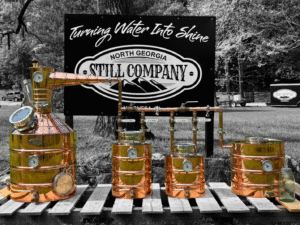
Even the familiar pot, cap, lyne arm, and worm condenser arrangement reflects generations of practical experimentation.
Modern variations, including thumpers and modular configurations, offer additional flexibility.
None of these designs are automatically superior for every type of spirit. What matters is choosing equipment that suits the intended product and understanding how its design affects performance.
For enthusiasts studying the history of American whiskey, learning about traditional pot still construction offers a connection to the people who developed and refined these techniques.
Is Hobby Distilling Legal in America Today?
This is an important part of understanding how the traditions of American moonshining relate to modern enthusiasts.
Although homebrewing beer and making wine for personal use are federally permitted within certain limits, distilling beverage alcohol at home without the required federal authorization remains illegal in the United States as of October 2026. But those outdated laws are currently being challenged in Federal Supreme Court.
Federal law generally requires distilled spirits to be produced at a properly qualified distilled spirits plant. State and local regulations may impose additional requirements.
Owning distilling equipment is not necessarily illegal. The federal Alcohol and Tobacco Tax and Trade Bureau (TTB) recognizes lawful uses for stills, including distilling water and extracting certain essential oils.
However, owning a still does not automatically authorize its use to produce beverage alcohol, even for personal consumption or without selling it. Certain equipment-registration requirements can also apply.
For hobbyists interested in the history and science of distilling, there are still meaningful ways to participate, including studying fermentation, researching historical recipes, collecting and restoring historic equipment, distilling water where permitted, and learning alongside properly licensed distillers.
The distinction between owning equipment, using it for nonalcoholic purposes, and producing beverage spirits is one that every enthusiast should understand.
It is also a reminder of how closely the history of American whiskey has always been connected to taxation, regulation, and the debate over who can legally produce distilled spirits.
Preserving an American Tradition for the Next Generation
One of the most interesting developments in modern American whiskey culture is the renewed appreciation for traditional methods.
As commercial distilling has grown more sophisticated, interest in historic grain varieties, small-batch techniques, and handcrafted equipment has also found a dedicated following.
People want to know more about what goes into making whiskey.
They want to understand why one variety of corn might taste different from another, why the shape of a still matters, and how traditional whiskey developed its unique characteristics.
For those of us who appreciate handcrafted copper stills, that growing curiosity is encouraging.
At North Georgia Still Company, we believe there is something special about the relationship between traditional equipment and the craft of distilling.
The materials, fabrication methods, and technology available today may be vastly different from those used by early Appalachian still makers, but there is still tremendous value in understanding where these designs came from.
A copper still isn’t simply a collection of metal components.
Its design reflects hundreds of years of experimentation, improvements, and knowledge passed from one generation to the next.
That history is part of what makes American whiskey so interesting.
The Spirit of American Whiskey Lives On
From the frontier farms of the 1700s to the hidden stills of Appalachia, American whiskey has always been shaped by the people making it.
Farmers turned their harvests into something valuable. Craftsmen built equipment with the materials they had available. Mountain families preserved traditions through generations of changing laws and economic conditions.
Along the way, they helped create a distinctly American distilling heritage.
Today, we have better tools, greater access to information, and a deeper scientific understanding of the processes those early distillers learned through experience.
But the fascination with traditional whiskey-making remains.
Perhaps that is the most important connection between yesterday’s moonshiners and today’s hobby distilling enthusiasts.
It’s not simply about making whiskey. It’s about understanding the process, appreciating the craftsmanship, and preserving a piece of American history.
And as long as people remain curious about the art and science behind a copper still, that tradition will continue to have a place in American culture.
Always follow applicable federal, state, and local laws concerning the production of distilled spirits. In the United States, producing distilled spirits for beverage purposes generally requires appropriate federal authorization and may also be subject to state and local requirements.