
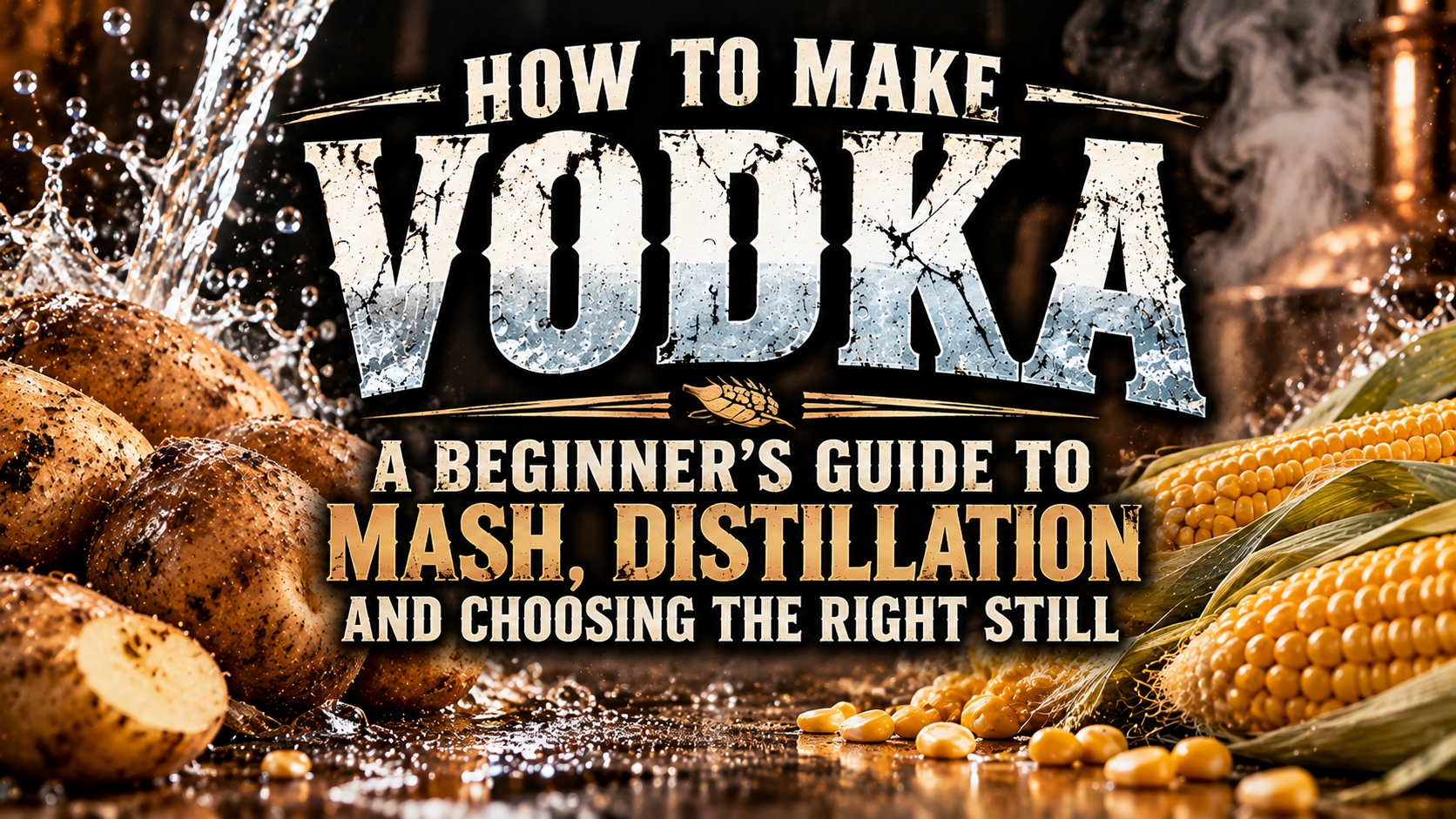
From traditional European potato vodka to American corn-based vodka, learn how vodka is made, why still design matters, and what it takes to produce a clean, smooth spirit.
When most people think about making homemade spirits, whiskey and moonshine are usually the first things that come to mind. But vodka is another fascinating spirit to study, and producing a truly good vodka can require just as much skill and attention to detail as making quality whiskey.
At first glance, vodka seems simple. Unlike whiskey, it generally isn’t aged in oak barrels, and unlike rum or brandy, it isn’t typically intended to showcase strong flavors from its original ingredients.
Instead, the goal is usually to create a clean, smooth, relatively neutral spirit.
But that simplicity can be deceiving.
Vodka leaves very little room to hide imperfections. Poor fermentation, undesirable compounds, or improper distillation can become noticeable in the finished product.
For hobby distilling enthusiasts, understanding vodka production is an excellent way to learn about fermentation, starch conversion, reflux, and the differences between traditional pot stills and more specialized distilling equipment.
Let’s explore how vodka is made, starting with its ingredients.
What Exactly Is Vodka?
Vodka is a distilled spirit typically produced from fermented grains, potatoes, or other agricultural materials containing fermentable sugars or starch.
Although vodka is often described as having no flavor, that isn’t entirely accurate.
Different vodkas can have subtle variations in texture, mouthfeel, aroma, and perceived sweetness.
A potato vodka may seem fuller or creamier, while corn vodka may be perceived as slightly sweeter. Grain-based vodkas can have delicate cereal characteristics.
These differences are generally much more subtle than those found in whiskey or brandy.
In the United States, vodka falls under the federal standard for neutral spirits, which requires distillation at or above 95% alcohol by volume (190 proof), with bottling at no less than 40% ABV (80 proof).
That high level of rectification is one reason why selecting the correct still is so important.
Traditional European Potato Vodka vs. American Corn Vodka
Potato vodka
Historically associated with Poland and other European potato-growing regions.
Corn vodka
A popular modern American style using readily available corn.
One of the more interesting aspects of vodka is that it can be made from different agricultural ingredients.
Traditional potato vodka
Potato vodka is strongly associated with Eastern and Northern Europe, especially Poland.
However, there is an important historical distinction: vodka was originally produced from grains, particularly rye and wheat, long before potatoes became widely used for distilling. Russian vodka also has a substantial grain-based tradition.
Potatoes became important to European vodka production during the late 1700s and 1800s because they could provide an economical source of starch for alcohol production.
Potatoes contain a considerable amount of water and a relatively modest concentration of starch compared with dried grain.
This means more raw material may be needed to produce the same amount of alcohol.
However, properly produced potato vodka can have a distinctive texture that many enthusiasts appreciate.
Some describe it as creamy, rounded, or slightly earthy, although these characteristics are not guaranteed simply because potatoes were used.
American corn vodka
Corn has become a recognizable ingredient in American craft vodka production.
One well-known example is Tito’s Handmade Vodka, which is distilled from corn in Texas.
Corn is attractive to American distillers because it is widely available, relatively inexpensive, and rich in starch.
Compared with potatoes, dry corn generally offers more potential fermentable material per pound.
Corn vodka is sometimes described as having a slightly soft or sweet character, even though properly fermented and distilled vodka contains little to no residual sugar before any permitted adjustments.
Not all American vodka is made from corn, however. American producers also use wheat, rye, potatoes, grapes, and other ingredients.
How do they compare?
| Characteristic | Potato vodka | Corn vodka |
| Raw material | Potatoes | Corn grain |
| Regional association | European traditions | Modern American craft production |
| Starch content | Relatively low by fresh weight | Relatively high |
| Mash preparation | Cooking and breaking down potatoes | Cooking and gelatinizing corn |
| Potential character | Creamy, rounded | Soft, subtly sweet |
| Processing challenge | Thick mash and solids | Thick mash and solids |
| Suitable still | Reflux/rectification still | Reflux/rectification still |
Both ingredients can produce excellent vodka. The biggest differences are in preparing the mash, starch conversion, fermentation, and the nuances retained after distillation.
Step 1: Understanding the Vodka Mash
Regardless of whether vodka starts with potatoes or corn, fermentation requires sugar.
Yeast consumes fermentable sugars and converts them into alcohol and carbon dioxide.
The challenge is that potatoes and corn contain most of their available carbohydrate in the form of starch rather than simple sugar.
Yeast cannot efficiently ferment ordinary starch directly.
That means the starch must first be converted into fermentable sugars.
This process is called saccharification.
How starch conversion works
In traditional grain and potato mashing, heat and enzymes perform different jobs.
First, heat and water cause starch granules to swell and gelatinize, making the starch more accessible.
Next, enzymes break the starch molecules into smaller carbohydrates.
Two important enzymes used in modern distilling are:
- Alpha-amylase: Breaks long starch molecules into shorter chains called dextrins.
- Glucoamylase: Breaks starch-derived chains down further, producing fermentable glucose.
Malted grain can also provide starch-converting enzymes, particularly in traditional mashing methods.
Without adequate conversion, a mash may contain plenty of starch but relatively little sugar that yeast can use.
This is why preparing a vodka mash is more involved than simply combining potatoes or corn with water and yeast.
Step 2: Preparing a Traditional Potato Vodka Mash
Potato mash preparation is different from traditional corn whiskey mash because fresh potatoes contain substantial moisture and relatively little sugar.
For educational purposes, the following describes the general production sequence used by licensed distillers.
Preparing the potatoes
The first stage is selecting sound potatoes and thoroughly washing away soil and debris.
Damaged or rotten potatoes should be rejected.
Potatoes are then chopped, crushed, or otherwise prepared so their starch can be accessed more effectively.
Cooking and gelatinization
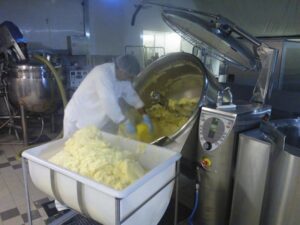
Potatoes are heated in water until their starch gelatinizes and the flesh softens.
Mechanical mixing or mashing breaks the cooked material down into a relatively uniform mixture.
This stage is important because intact potato pieces are difficult to convert efficiently.
Thick potato mash also creates handling challenges. Without proper equipment, it can be difficult to mix evenly and may scorch when exposed to direct heat.
Converting the starch
Once the potatoes are cooked, the mash must undergo enzymatic conversion.
A licensed distiller may use malted grain or commercial enzymes, selecting temperatures and conditions based on the conversion system.
The purpose is to create a sugar-rich liquid that yeast can ferment.
The starch conversion process must be reasonably complete to obtain an efficient fermentation.
Separating solids and fermenting
Depending on the production method, some or all of the potato solids may be separated before fermentation.
The converted mash or liquid is then cooled to a temperature suitable for the selected yeast.
A fermentation vessel should be food-safe, clean, and able to release carbon dioxide without allowing unwanted contamination.
Healthy fermentation produces alcohol along with many other compounds that influence the quality of the resulting spirit.
Why potato mash can be challenging
Potato fermentation often involves more processing than a simple sugar wash.
Because fresh potatoes contain relatively little starch per pound, producing a useful amount of fermentable sugar can require a substantial quantity of potatoes.
The thick consistency also creates greater challenges for stirring, pumping, and cleaning.
Nevertheless, potato vodka remains an important traditional spirit with a distinctive agricultural history.
Step 3: Preparing an American Corn Vodka Mash
Corn vodka uses many of the same fundamental principles as traditional corn whiskey.
The primary difference is the intended finished spirit.
With corn whiskey, distillers may want to preserve a noticeable amount of grain character.
For vodka, the objective is to produce a highly rectified, comparatively neutral spirit.
Selecting and preparing corn
Licensed distillers often begin with milled or cracked corn.
Breaking the grain into smaller pieces exposes more of the starch to water and enzymes.
Corn may be inexpensive and readily available, but proper preparation is still essential.
Cooking the corn
Corn starch generally requires substantial heating to gelatinize efficiently.
During the cooking stage, the mixture thickens as the starch absorbs water.
Adequate mixing helps distribute heat and prevents scorching.
Commercial distilleries may use steam-jacketed kettles or specialized mash cookers, particularly when working with thick grain mashes.
Enzymatic conversion
As with potato mash, corn mash needs starch-converting enzymes.
Alpha-amylase is commonly used to reduce mash viscosity and break down starch molecules.
Additional enzymes or malted grain can convert the resulting carbohydrates into sugars suitable for fermentation.
The appropriate temperatures, pH, and enzyme quantities depend on the specific grain, equipment, and enzyme products.
Fermenting the corn mash
Once the starch has been converted, the mash is cooled and prepared for yeast fermentation.
A healthy fermentation depends on suitable yeast, sanitation, adequate nutrition, and appropriate temperature control.
The resulting fermented liquid is sometimes referred to as a wash or beer.
For vodka, licensed distillers generally favor clean, controlled fermentation because undesirable fermentation compounds create additional challenges during rectification.
Can corn whiskey mash be used to make vodka?
Yes, in principle.
The same basic corn-derived fermented material can be used to produce very different spirits depending on the distillation equipment and production methods.
A traditional pot still may preserve more corn character, making the distillate better suited to a corn whiskey style.
A highly efficient rectification system can remove far more of those compounds, producing neutral spirit suitable for vodka.
That brings us to one of the most important decisions in vodka production: choosing the right still.
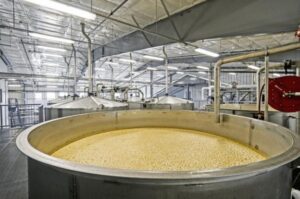
Step 4: What Type of Still Makes the Best Vodka?
Traditional pot still
Designed to retain more of the character of the fermented material.
Reflux still
Designed to achieve greater separation and higher-purity alcohol.
Not all stills operate the same way.
While a simple copper pot still can produce excellent whiskey, brandy, and other flavorful spirits, vodka generally requires a different approach.
Traditional pot stills
A pot still works by heating fermented liquid, collecting vapor, and condensing it back into liquid.
Traditional pot stills provide limited internal reflux compared with dedicated rectification columns.
That means more flavor compounds may carry through with the alcohol.
For whiskey, rum, and brandy, this is often desirable.
For vodka, it can make achieving a very neutral spirit difficult.
Multiple distillations can increase purity, but repeatedly running a basic pot still is generally less efficient than using a well-designed rectification column.
There are commercial vodkas produced using pot-still-based processes, but that does not mean a single pass through a simple pot still will produce neutral spirit.
Reflux stills: The preferred choice for vodka
For someone studying equipment specifically suited to vodka production, a reflux still is generally the most practical design to understand.
A reflux still incorporates a column that allows rising vapor and descending condensed liquid to interact.
This creates repeated opportunities to separate alcohol from water and other compounds.
The result is greater rectification than would ordinarily occur in a simple pot still.
A well-designed reflux column can produce extremely high-proof neutral spirit when operated correctly.
Why column height and packing matter
Inside many reflux stills is a column filled with structured packing or another material that provides surface area for vapor and liquid contact.
Common packing materials include stainless steel and copper.
Column performance depends on several factors, including height, diameter, packing, vapor flow, heat input, and reflux control.
A taller column can provide more separation stages, but height alone does not guarantee better performance.
For vodka, column design is often more important than the appearance of the boiler beneath it.
The importance of reflux control
A reflux condenser returns some condensed vapor to the column.
This returning liquid interacts with rising vapor, improving separation.
The amount returned compared with the amount collected is referred to as the reflux ratio.
Greater reflux can improve separation, although it generally reduces the rate at which finished distillate is collected.
Commercial vodka production often relies on substantial rectification to produce a neutral spirit.
Copper or stainless steel?
Both copper and stainless steel have useful roles in vodka stills.
Copper can help remove certain undesirable sulfur compounds, while stainless steel offers durability, easy cleaning, and relatively low maintenance.
For this reason, a hybrid design can make considerable sense.
A copper boiler or copper components in the vapor path, combined with a stainless steel packed reflux column, can provide a useful combination of traditional materials and modern design.
However, a well-engineered stainless still with appropriate copper contact can also perform very well.
Step 5: Distillation and Rectification
Once fermentation is complete, a licensed distiller can process the fermented wash through suitable distillation equipment.
There are two broad approaches.
Pot distillation concentrates alcohol while preserving varying amounts of other volatile compounds.
Rectification uses repeated vapor-liquid contact to separate compounds more effectively, producing a higher-purity spirit.
In a dedicated vodka still, the objective is to produce neutral spirit rather than preserve a strong grain or potato character.
This is where reflux columns offer a major advantage.
A properly designed rectification system can approach the ethanol-water azeotrope, around 95–96% ABV, depending on operating conditions.
It is important to understand that 190 proof alcohol is not simply ordinary whiskey at a higher strength.
The distillation processes are designed around different goals.
Also, distilling to a high proof does not automatically establish beverage safety. Equipment materials, fermentation hygiene, process control, and appropriate quality testing remain important. Methanol and other contaminants cannot reliably be evaluated using a jar shake, flame test, or proof reading alone.
Step 6: Filtration, Water, and Proofing
After rectification, vodka production still isn’t finished.
The spirit typically undergoes proof adjustment and may also be filtered.
Why water is so important
Since vodka is generally intended to be neutral, the quality of the water used for dilution can have a noticeable effect on the finished product.
Commercial producers may use filtered, demineralized, or reverse-osmosis-treated water.
The goal is generally to avoid unwanted mineral tastes, cloudiness, and other characteristics that could affect the spirit.
Proofing the vodka
Vodka is commonly bottled at 40% alcohol by volume, equivalent to 80 proof in the United States.
Reducing high-proof neutral spirit to bottling strength requires accurate measurements and controlled blending.
Distillers also account for the fact that alcohol and water do not combine with perfectly additive volumes.
Proofing should be verified using appropriate calibrated instruments and temperature corrections, rather than estimates.
Does vodka need charcoal filtration?
Not necessarily.
Activated carbon filtration can remove certain trace compounds that influence aroma and flavor.
Some commercial producers use charcoal extensively, while others prefer to rely primarily on high-quality rectification.
Filtration cannot correct every production problem, and excessive filtration can remove some of the subtle characteristics a distiller may wish to retain.
A clean fermentation and effective rectification process are more fundamental than trying to correct a poorly produced spirit afterward.
Can You Make Vodka With a Regular Moonshine Still?
This is one of the questions enthusiasts frequently ask.
A traditional pot still can concentrate alcohol from a fermented wash, but it generally cannot achieve the same purity in a single pass as an effective packed reflux column.
That matters because vodka is intended to be a highly rectified spirit.
The equipment selected for whiskey may therefore be less suitable for vodka.
One option in modern equipment design is a modular system that can operate in different configurations.
For example, a boiler may support a traditional pot-still head for flavorful spirits or a packed rectification column for neutral spirits.
This allows the same base vessel to serve different purposes, provided the connections, heating system, condenser capacity, and operating design are appropriate.
For enthusiasts interested in understanding several styles of distilling, modular equipment offers an opportunity to study the differences without relying on completely separate boiler systems.
What Size Vodka Still Should a Hobby Enthusiast Consider?
Still size is another consideration, but bigger isn’t automatically better.
Someone learning about the process may find a smaller system easier to study, clean, and maintain.
A larger system can accommodate more fermented wash, but it also requires more space, greater heating capacity, and appropriately sized condensers.
For vodka, the design of the reflux column matters at least as much as the volume of the boiler.
Here are some of the most useful factors to evaluate:
- Boiler construction: Heavy-duty materials and quality welding.
- Column design: Appropriate height, diameter, packing, and reflux condenser configuration.
- Heating method: Stable, controllable heat input suitable for the equipment.
- Connections: Secure, serviceable fittings that permit cleaning and maintenance.
- Condenser capacity: Adequate cooling capability for the system’s rated output.
- Cleanability: Access for inspecting and cleaning components that contact the product.
At North Georgia Still Company, we believe a still should be chosen for what the owner wants to learn and produce, rather than simply selecting the largest or most expensive equipment.
Traditional copper pot stills, reflux systems, and modular configurations each have their place.
Understanding the differences makes it easier to select equipment that matches the intended application.
Common Mistakes in Vodka Production
Even though vodka is considered a relatively simple spirit, quality production requires attention to detail.
Some common issues include incomplete starch conversion, poor fermentation conditions, scorching thick mash, inadequate equipment cleaning, and insufficient rectification.
A few principles are especially important.
Don’t overlook fermentation. A good reflux system cannot make every fermentation defect disappear.
Don’t assume more distillations automatically mean better vodka. Column efficiency and proper operation matter more than a marketing claim about how many times the spirit was distilled.
Don’t underestimate water quality. Water makes up a substantial portion of bottled vodka and can influence its character.
Don’t confuse high proof with high quality. Purity, flavor, equipment safety, and process control are separate considerations.
Don’t expect every vodka ingredient to produce a dramatic flavor difference. Effective rectification removes much of the original ingredient’s character, making differences between potato, corn, rye, and wheat vodkas subtler than many people expect.
Is Making Vodka at Home Legal in the United States?
One important distinction applies to American hobbyists.
As of October 2026, federal law does not permit producing beverage alcohol at home for personal use without the required distilled spirits plant authorization. This restriction applies to vodka just as it does to whiskey, rum, and brandy.
Beer and wine have separate federal home-production exemptions; distilled spirits do not. State and local requirements may add further restrictions.
Owning a still for lawful purposes, such as distilling water or extracting essential oils, is different from using it to produce beverage alcohol.
Hobbyists can still explore many aspects of the craft through legal fermentation projects, water distillation, equipment study, and educational opportunities with licensed producers.
Anyone intending to produce beverage spirits should first understand the federal, state, and local requirements for licensed distillation.
Final Thoughts: Great Vodka Starts Long Before the Still
When we think about vodka, it’s easy to imagine that the goal is simply to create the highest-proof alcohol possible.
But there is considerably more to producing a great vodka.
The original ingredients matter. Starch conversion matters. Healthy fermentation matters. And perhaps most importantly, the design of the distilling equipment matters.
Traditional European potato vodka and modern American corn vodka illustrate how two very different agricultural ingredients can be transformed into spirits with similar goals but subtly different characteristics.
For hobby enthusiasts interested in learning about vodka, understanding reflux distillation is particularly valuable.
Traditional pot stills are excellent examples of the art of preserving flavor, while reflux columns demonstrate the science of separating and refining a spirit.
Neither approach replaces the other. They simply serve different purposes.
Ultimately, great vodka isn’t about how little effort goes into making it. It’s about how much knowledge and precision go into creating something that tastes so clean and simple.
And that is what makes the study of vodka production every bit as interesting as traditional whiskey or moonshine.
Always follow applicable federal, state, and local laws concerning the production of distilled spirits. In the United States, producing distilled spirits for beverage purposes generally requires appropriate federal authorization and may also be subject to state and local requirements.