Walk into almost any traditional whiskey distillery and one thing immediately stands out:
Copper.
Those large copper pot stills aren’t made that way simply because copper looks good. Copper has been used in distilling for generations, and its role goes beyond tradition or appearance.
Today, however, stainless steel is increasingly common in distilling equipment. It’s strong, durable, relatively easy to maintain, and works extremely well for certain components.
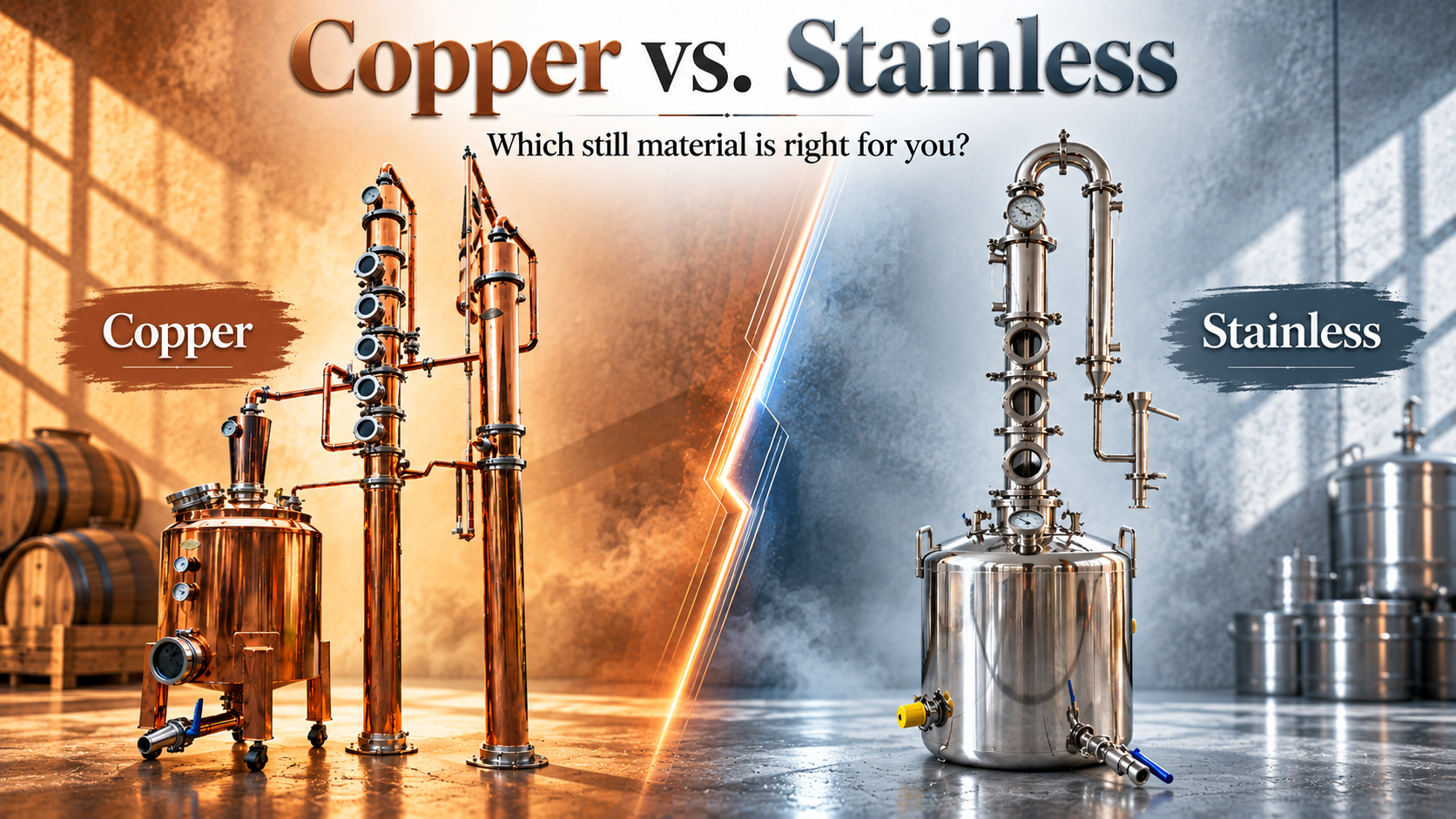
So, which is better?
Copper or stainless steel?
At North Georgia Still Company, we’re admittedly partial to copper.
We build traditional handcrafted copper stills because we believe copper offers benefits that stainless steel simply doesn’t provide on its own—particularly where fermented liquid and vapor are concerned.
That doesn’t mean we dislike stainless.
In fact, we use stainless steel regularly.
We just believe the two materials have different jobs.
Why Has Copper Traditionally Been Used for Stills?
Copper has been associated with distillation for centuries.
Part of that history comes from practical characteristics that made copper an excellent material for forming vessels. It can be shaped, worked, joined, repaired, and fabricated into the complex curves traditionally associated with pot stills.
But there’s another reason copper remained important long after other materials became available:
Copper interacts with the distillation process itself.
Fermentation naturally produces numerous compounds in addition to ethanol. Among them are sulfur-containing compounds, some of which can contribute to undesirable aromas often described as sulfurous, vegetal, onion-like, meaty, or otherwise unpleasant when present at sufficient levels.
Copper is reactive.
When fermented vapor encounters copper during distillation, copper can interact with sulfur compounds and help reduce the amount of certain undesirable sulfur character that makes its way into the finished distillate.
That is one of the most important reasons copper continues to have a place in modern distillation.
It’s not just holding the product.
It’s participating in the process.
Copper Contact Can Influence Spirit Character
This is where the copper-versus-stainless discussion becomes more important than simply asking which material lasts longer.
Stainless steel is intentionally much less reactive.
That’s one of stainless steel’s greatest strengths. It’s extremely useful when you want a strong, corrosion-resistant surface that doesn’t readily interact with what’s inside it.
But distillation is one situation where some material interaction can actually be beneficial.
Research into whisky distillation has shown that copper contact can reduce sulfur-related compounds and sulfur-associated aromas in new-make spirit. Studies comparing copper and non-copper components have also demonstrated that where copper contact occurs within the still can influence the resulting spirit.
That doesn’t mean an all-stainless still can’t produce distillate.
Of course it can.
The question we ask is different:
If copper contact can contribute something useful to the process, why eliminate it?
For the type of traditional equipment we build, we’d rather take advantage of copper.
Why North Georgia Still Company Prefers Copper
Our preference for copper is really based on three things:
Tradition
There’s something special about building a still from copper sheet in much the same spirit that still makers have done for generations.
Distilling has an incredibly rich history, and the copper pot still is part of that history.
We don’t believe every old way of doing something is automatically better simply because it’s old.
But when tradition also has a practical purpose, we think it’s worth preserving.
Function
Copper isn’t merely decorative.
Its interaction with sulfur compounds gives it a functional role in distillation that stainless steel doesn’t naturally provide to the same degree.
For us, that’s an important distinction.
Craftsmanship
There’s also no getting around this one:
A handcrafted copper still has character.
Copper changes appearance as it’s worked. Every hammer mark, TIG weld, joint, rivet, curve, and fabricated component becomes part of the finished piece.
Two handcrafted copper stills will never feel exactly the same.
We aren’t interested in simply assembling tanks and calling them stills.
We enjoy building equipment that looks like what it is:
a piece of traditional distilling equipment made by craftsmen.
So, What’s Wrong With Stainless Steel?
Nothing.
Seriously.
Stainless steel is an excellent material.
It has become incredibly common throughout modern food, beverage, brewing, and distilling operations for good reason.
Stainless steel is:
- Extremely durable
- Corrosion resistant
- Relatively easy to clean
- Strong
- Well suited to sanitary fittings
- Excellent for structural components
- Ideal for many tanks, piping systems, and accessories
If this article were simply about which material was easier to maintain, stainless would have a very strong argument.
But we don’t believe that’s the only thing that matters when choosing material for a still.
Sometimes Stainless Steel Is Exactly the Right Choice
This is why you’ll see stainless incorporated into some North Georgia Still Company equipment.
We’re not trying to avoid stainless at all costs.
We’re trying to use each material where it makes sense.
Tri-clamp fittings are a great example.
Stainless tri-clamp components are durable, readily available, easy to disassemble, easy to clean, and make a modular still much more convenient to use.
Stainless can also work beautifully for:
- Tri-clamp ferrules and connections
- Structural support
- Hardware
- Certain condenser components
- Bands and decorative accents
- Frames and mounting systems
- Components where durability is more important than copper contact
Some of our custom stills even intentionally combine polished stainless steel with copper because the contrast between the two materials creates an incredible finished appearance.
That’s especially true on our one-of-a-kind builds.
We don’t see copper and stainless as enemies.
They’re tools.
The important thing is knowing which tool belongs where.
What About a Stainless Still with Copper Components?
This can be a very practical compromise.
A stainless boiler combined with copper somewhere in the vapor path allows a distiller to take advantage of some copper contact while retaining many of stainless steel’s durability and maintenance advantages.
That’s one reason you’ll see copper used inside otherwise stainless distilling systems.
For some people, that configuration makes perfect sense.
But when we’re given the choice between building the primary spirit-contact portions of a traditional pot still from copper or making everything stainless simply because stainless is easier to maintain, we still prefer copper.
The material isn’t an inconvenience we’re trying to engineer out of the process.
It’s part of what we want the still to do.
Is More Copper Always Better?
This deserves some nuance.
Simply adding as much copper as physically possible doesn’t automatically guarantee better spirit.
Distillation involves a huge number of variables:
- Fermentation
- Yeast
- Grain or other raw materials
- Still design
- Heat input
- Vapor speed
- Reflux
- Copper contact
- Condenser design
- Cut points
- Operator technique
- Aging and maturation
Copper is one part of a much larger system.
Even scientific research into copper during whisky production shows that the chemistry is more complicated than saying, “Copper removes everything bad.”
Different sulfur compounds can behave differently, and copper can participate in multiple chemical reactions during distillation.
What we can say is that copper contact has repeatedly been shown to influence sulfur chemistry and the sensory character of distilled spirit.
That’s enough reason for us to continue giving copper an important role.
What About Copper Mesh in a Stainless Still?
Some stainless still designs use copper mesh, copper packing, or removable copper components to introduce copper contact into the vapor path.
That approach can absolutely provide copper surface area.
It’s particularly common in column-style equipment where packing is already part of the design.
But there’s a difference between adding some copper to a stainless still and actually building major portions of the still from copper.
In a traditional copper pot still, the wash and vapor can come into contact with substantial copper surface area throughout the process.
That’s the approach we prefer.
It isn’t the only way to build a functioning still.
It’s simply the philosophy behind the equipment we choose to make.
Copper Requires More Care
We should also be fair about the disadvantages.
Copper requires more attention than stainless steel.
It can tarnish.
It develops patina.
Its appearance changes over time.
Reactive copper surfaces also need to be kept appropriately clean for the equipment to perform as intended.
Someone wanting equipment that stays bright and unchanged with minimal cosmetic maintenance may find stainless more appealing.
But for many people who love traditional stills, copper aging is part of the appeal.
A copper still that’s actually being used shouldn’t necessarily look like a brand-new decorative lamp forever.
It develops character.
And personally, we think that’s a good thing.
Copper and Stainless Can Look Incredible Together
There is another reason we occasionally mix the two materials:
They look great together.
The warmth of copper next to stainless steel creates a contrast that’s difficult to duplicate with any other combination.
That’s something we’ve explored heavily in some of our custom builds at North Georgia Still Company.
Stainless bands.
Copper rivets.
Stainless connections.
Hand formed copper vessels.
TIG-welded components.
These aren’t necessarily traditional combinations in the strictest historical sense, but they allow us to combine old-world copper still making with modern fabrication techniques.
That’s an area where we think stainless absolutely has a place.
All-Copper vs. Hybrid vs. Stainless: Which Should You Choose?
There isn’t one universal answer.
An all-copper or predominantly copper still may be right for you if:
You value traditional still construction.
You want substantial copper contact throughout the system.
You’re interested in whiskey, brandy, rum, or other spirits where traditional pot-still character is important to you.
You appreciate handcrafted equipment.
And you don’t mind giving copper a little extra care.
A hybrid copper-and-stainless still may be right for you if:
You want meaningful copper contact while taking advantage of stainless steel in certain areas.
You like modern tri-clamp connections and modular components.
You want some of the durability and convenience of stainless without eliminating copper from the system.
Or you simply love the visual combination of the two materials.
A predominantly stainless still may be right for you if:
Durability and ease of maintenance are your highest priorities.
You need a particular column or commercial configuration.
You prefer stainless fabrication.
Or your equipment design provides the copper contact you want through packing or other components.
None of those choices are automatically wrong.
They simply reflect different priorities.
Our Philosophy: Use Stainless Where It Helps. Keep Copper Where It Matters.
That’s probably the simplest way to explain North Georgia Still Company’s approach.
We prefer copper.
We prefer the history of it.
We prefer working with it.
We prefer the appearance of it.
Most importantly, we prefer having copper actively involved in the distillation process rather than trying to eliminate it from the equipment.
But we aren’t afraid of stainless steel.
When stainless provides a better connection, stronger structural component, cleaner modular design, or better solution for a specific part of the still, we’ll use it.
Some of our favorite builds combine both materials.
The difference is that we don’t begin with the assumption that stainless should replace copper everywhere possible.
We begin with copper.
Then we ask:
Where does stainless make this still better?
There’s a Reason Copper Stills Are Still Being Built
Modern distillers have access to materials and fabrication technology that still makers hundreds of years ago couldn’t have imagined.
And yet copper pot stills haven’t disappeared.
That’s worth thinking about.
Copper survived the transition into modern distilling because it isn’t simply an outdated material waiting to be replaced.
It brings characteristics to the process that distillers still value today.
At North Georgia Still Company, we’re proud to continue that tradition.
We just aren’t afraid to add a little stainless steel when the build calls for it.
Traditional copper. Modern fabrication. Built one still at a time.
Always follow applicable federal, state, and local laws concerning the ownership and use of distilling equipment and the production of distilled spirits.