
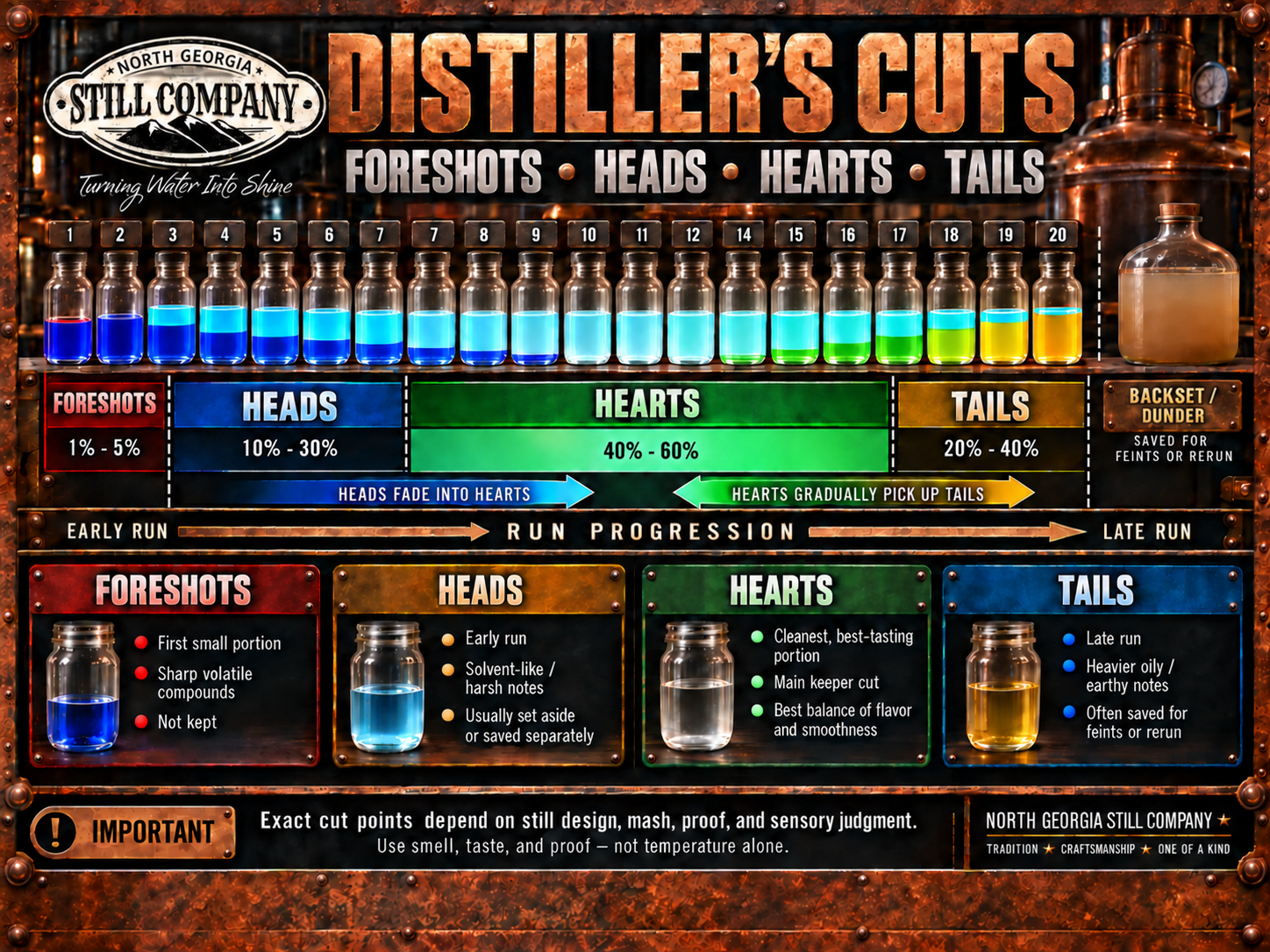
Making cuts is one of the most important skills a new distiller can learn.
It’s also one of the things that makes distilling so interesting.
There isn’t one exact number that tells everyone when to switch from heads to hearts, or hearts to tails.
You can use temperature and proof as helpful clues, but ultimately your nose, taste, and feel are what make the final decision.
Why Do We Make Cuts?
As a distillation run progresses, different compounds come through at different times.
We separate the run into three basic sections:
Heads – the earlier portion, often sharper, hotter, more solvent-like, or chemically tasting.
Hearts – the clean, pleasant portion you generally want to keep.
Tails – the later portion, where heavier, oily, earthy, bitter, or damp flavors begin appearing.
The purpose of making cuts is primarily quality.
Where you make those cuts determines the aroma, flavor, smoothness, and overall character of the finished spirit.
A wider hearts cut may give you more flavor and character. A tighter hearts cut may produce something cleaner and lighter. That choice is part of what makes each distiller’s spirit different.
Temperature Can Help — But Don’t Chase a Number
Temperature is useful for understanding where you are in the run, but it shouldn’t be related as an automatic cut point.
As alcohol is distilled from the boiler, the boiling mixture changes and temperatures generally rise. That gives you useful information about how the run is progressing.
But mash composition, still design, elevation, thermometer placement, and other factors can all affect the temperature you see.
**Use temperature as a guide—not as the final answer. **
Proof Is Another Helpful Clue
Watching the proof of your distillate is another good way to follow the progression of a run.
You can measure it accurately with a Proof and Tralles hydrometer/alcoholmeter once the sample is cooled to the appropriate temperature.
Or you can use the old-fashioned jar shake method.
Give a small jar of distillate a shake and watch the bubbles.
Generally, higher-proof spirit produces smaller bubbles that disappear relatively quickly, while lower-proof spirit tends to behave differently. It can give an experienced distiller a rough idea of what’s happening, but it’s nowhere near as precise as an alcoholmeter.
The important thing to remember is that there is no universal proof where heads suddenly become hearts or hearts suddenly become tails.
Proof tells you where you are in the run. Your senses tell you what you want to keep.
Your Senses Are Your Best Tools
This is where distilling becomes part science and part craft.
Smell
Heads commonly have sharper aromas that people describe as solvent-like, chemical, nail-polish-like, or overly pungent.
As you move into the hearts, those harsh aromas usually begin fading and the spirit becomes cleaner and more pleasant.
As tails arrive, you may begin noticing heavier, earthy, musty, grainy, oily, or wet-cardboard-type aromas.
Taste
Taste can help confirm what your nose is telling you.
For high-proof samples, dilute a very small sample with water before tasting it.
The hearts should generally contain the flavors you want in your finished spirit.
Once unpleasant bitterness, heaviness, or other late-run flavors begin becoming noticeable, you may be entering the tails.
Feel
You can also learn a surprising amount from how the distillate feels.
Rub a couple drops between your fingers.
As the run progresses, you may notice changes in how oily or slick the spirit feels, particularly as you move farther into the tails.
With experience, these little clues become easier to recognize.
The Best Beginner Method: Use Lots of Small Jars
One of the easiest ways to learn cuts is not to try making perfect cuts while the still is running.
Instead, collect your run in a series of small, numbered jars.
For example:
**Jar 1 → Jar 2 → Jar 3 → Jar 4 → Jar 5…**
Collect roughly equal portions in each jar and keep them in order.
Once the run is finished, let the samples breathe for a while, then work your way through them in order.
Smell each one. Dilute tiny samples for tasting. Compare them side by side.
You’ll often notice the transition very clearly:
**Heads → heads fading → clean hearts → hearts picking up tails → tails**
Then you can decide where your hearts cut begins and ends and combine the jars you like.
This method takes a lot of the pressure off a beginner because you don’t have to make every decision in real time.
There Is No Perfect Cut
Two people can run the exact same mash through the exact same still and make slightly different cuts.
And both can be right.
One person may enjoy a little more of the early character. Another might cut deeper into the tails because they like the heavier grain flavors. Someone else may make extremely tight cuts for a very clean spirit.
That’s part of what makes distilling unique.
Temperature helps. Proof helps. But your nose, taste, and feel ultimately determine your cuts.
And the best way to get good at making cuts?
Practice.
Every run teaches you something. The more you smell, taste, compare, and take notes, the easier those transitions become to recognize—and the more your finished spirit starts developing a character that is uniquely yours.
Always follow applicable federal, state, and local laws concerning the production of distilled spirits. In the United States, producing distilled spirits for beverage purposes generally requires appropriate federal authorization and may also be subject to state and local requirements.