One of the most confusing parts of buying your first still is figuring out what type of still you actually need.
Do you need a traditional pot still?
Should you add a thumper?
Would a reflux column be better?
And what happens if you eventually want to make something different?
The answer depends less on which design is “best” and more on what you’re trying to accomplish.
At North Georgia Still Company, we generally like equipment that gives the distiller options. A traditional pot still is an excellent foundation, and a modular system can allow you to add a thumper, different columns, or other components as your interests grow.
Here’s how the basic configurations compare.
What Is a Pot Still?
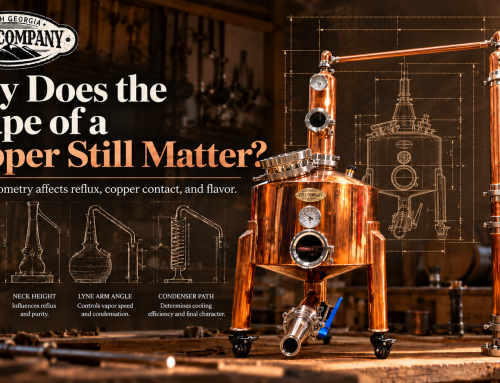
A traditional pot still is one of the simplest and oldest forms of distilling equipment.
At its most basic, you have:
- A boiler
- A head or column
- A vapor path
- A condenser
The fermented wash or mash is heated in the boiler. Alcohol and other volatile compounds vaporize, travel through the still, and are then cooled back into liquid by the condenser.
Pot stills generally allow more flavor from the original fermentation to carry through into the distillate than a high-reflux system.
That’s one reason they’re traditionally associated with flavorful spirits such as:
Whiskey, bourbon-style spirits, rum, brandy and other full-flavored distillates.
For someone whose main interest is whiskey making, a good copper pot still is often a very logical place to start.
Why Choose a Pot Still?
One of the biggest advantages is simplicity.
A straightforward pot still gives a beginner an opportunity to learn the fundamentals without adding unnecessary complexity.
You can begin learning:
- Heat control
- How your condenser behaves
- How the output changes throughout the run
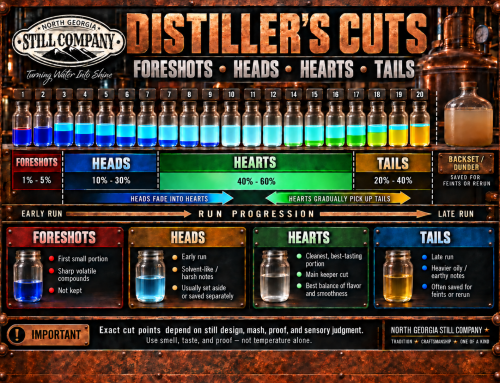
- Heads, hearts, and tails
- How different fermentations affect the finished distillate
- How your particular still responds to changes
Pot stills also tend to preserve more character from the raw ingredients.
If you’ve spent time developing a grain recipe, molasses wash, or fruit fermentation, you may actually want some of that character to make it through the still.
That’s exactly where the pot still shines.
What Is a Thumper?
A thumper—sometimes called a doubler—is a secondary vessel installed between the main boiler and condenser.
Instead of vapor leaving the boiler and traveling directly to the condenser, it first enters the thumper.
The incoming hot vapor heats the liquid inside the thumper, causing another stage of vaporization before the vapor continues toward the condenser.
In simple terms:
A thumper gives you an additional distillation effect during a single run.
That makes it especially popular with traditional whiskey and rum setups.
Do You Need a Thumper?
No.
A thumper isn’t required to make good spirits.
A basic pot still can be an excellent setup on its own.
But a thumper can be useful depending on what you want from the equipment.
It can increase the amount of separation occurring during the run and can often increase the proof coming from the still compared with a simple single-pass pot still arrangement.
A thumper can also be used creatively.
Depending on the recipe and process, distillers may charge a thumper with liquid from a previous run or other appropriate ingredients to influence the character of the resulting spirit.
That flexibility is part of what makes thumpers interesting.
Pot Still with a Thumper vs. Without One
So, which should you choose?
A simple pot still may be better if:
You’re completely new to distilling.
You want the simplest possible system to learn.
You primarily want traditional flavorful spirits.
You want fewer components to clean and maintain.
Or you simply don’t need the additional separation a thumper provides.
A pot still with a thumper may be better if:
You want a traditional whiskey-style configuration.
You’d like additional separation in a single run.
You want to experiment with how the thumper affects flavor and proof.
Or you simply want another tool available as your skills develop.
This is one reason we like removable thumpers.
You don’t necessarily have to make a permanent decision.
Run the still without it when that’s what you want.
Connect the thumper when the recipe or process calls for it.
What Is a Reflux Still?
A reflux still takes a different approach.
Instead of simply allowing vapor to travel out of the boiler and directly toward the condenser, a reflux system intentionally causes some of that vapor to condense inside the column and travel back downward.
That liquid is heated and vaporized again.
This repeated evaporation and condensation creates additional separation inside the column.
The more effective the reflux, the greater the separation between ethanol, water, and other volatile compounds can become.
The result can be a higher-proof and more neutral distillate compared with what you’d typically expect from a simple pot still.
When Does a Reflux Still Make Sense?
Reflux systems are particularly useful when the goal is purity and neutrality rather than retaining as much flavor from the fermentation as possible.
They’re commonly associated with producing a cleaner, higher-proof neutral base.
That can make them useful when creating spirits where the distiller does not necessarily want a heavy grain, molasses, or fruit character carrying over.
But that additional separation comes with a tradeoff.
The same process that helps create a cleaner neutral spirit can also remove some of the flavors you may actually want when producing whiskey, rum, or brandy.
That’s why we don’t really think of pot and reflux stills as competitors.
They’re different tools designed to accomplish different things.
Pot Still vs. Reflux Still
A simple way to think about the difference is:
Pot Still = more flavor and character
Reflux Still = more separation and neutrality
That’s obviously a simplified explanation, because still design and operator technique create a lot of variation.
But for someone trying to decide between the two, it’s a useful starting point.
If your dream is making flavorful grain spirits and learning traditional pot distillation, we’d generally point you toward a pot still.
If your primary goal is producing a cleaner, higher-proof neutral spirit, a reflux configuration may make more sense.
What About Whiskey?
We get asked about this one a lot.
What’s the best still for whiskey?
For traditional whiskey-style distillation, we’re partial to copper pot stills.
Whiskey is supposed to have character.
Grain choice, fermentation, yeast, distillation, cuts, and eventually aging all contribute to that character.
A pot still allows more of those flavor compounds to remain part of the conversation.
Adding a thumper can give you another traditional option without turning the system into a high-reflux neutral-spirit still.
That’s one reason a copper pot still with an optional thumper can be such a versatile whiskey setup.
The Advantage of a Modular Still
This is where modern still design becomes really useful.
You don’t necessarily have to choose one configuration and live with it forever.
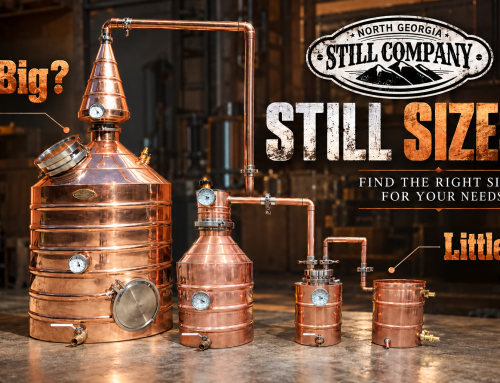
A modular still using tri-clamp connections can allow different components to be installed or removed depending on what you’re making.
For example, the same boiler could potentially be configured as:
Simple Pot Still
Boiler → Pot Still Head → Condenser
Pot Still with Thumper
Boiler → Pot Still Head → Thumper → Condenser
Column Configuration
Boiler → Appropriate Column → Condenser/Reflux Components
The exact equipment required will depend on the still design, but the idea is simple:
One good boiler can become the foundation for several different configurations.
For someone who enjoys experimenting, that’s a major advantage.
Don’t Buy Components Just Because They Look Impressive
It’s easy to look at a still covered in sight glasses, columns, plates, valves, and additional vessels and assume that more equipment automatically means better equipment.
It doesn’t.
Every component should have a reason for being there.
If all you want to do is learn traditional pot distillation, you may be perfectly happy with a straightforward copper pot still.
If you later decide you want a thumper, a well-designed modular system can allow you to add one.
If your interests move toward reflux distillation, you can explore a column designed for that purpose.
Buy the equipment that fits what you’re trying to make.
So, Which Still Do You Actually Need?
For a beginner, here’s how we’d simplify it:
Want to make flavorful whiskey, rum, or brandy?
Start with a pot still.
Want a traditional whiskey-style setup with additional separation?
Consider a pot still with a thumper.
Want to produce a cleaner, higher-proof, more neutral spirit?
Look toward a reflux still or reflux column configuration.
Not sure what you’ll want six months from now?
Consider a modular still that allows components to be added or removed.
That’s often the approach we prefer.
You can start simple, learn the fundamentals, and let your equipment grow along with your knowledge.
Start With What You Actually Want to Make
Before buying a still, ask yourself one question:
What type of spirit am I most interested in making?
That answer will tell you far more than simply asking which still has the most features.
At North Georgia Still Company, we’re big fans of traditional copper pot stills because we appreciate flavorful spirits, traditional distillation, and the role copper plays in the process.
But we also believe your still should fit your goals.
Sometimes that means a simple pot still.
Sometimes it means adding a thumper.
Sometimes a reflux column is the right tool.
And sometimes the best answer is to build a modular system that can do a little bit of everything.
Choose the configuration based on the spirit, not the number of parts attached to the still.
Always follow applicable federal, state, and local laws concerning the ownership and use of distilling equipment and the production of distilled spirits.