Ever wonder why two copper stills can look completely different?
One might have a short, wide pot with a large onion-shaped head. Another may be tall and narrow. One lyne arm points upward while another type slopes down toward the condenser.
Some stills are round. Some are squatty. Some are tall. And occasionally, you’ll come across something that doesn’t look like any still you’ve seen before.
A lot of those differences aren’t just cosmetics.
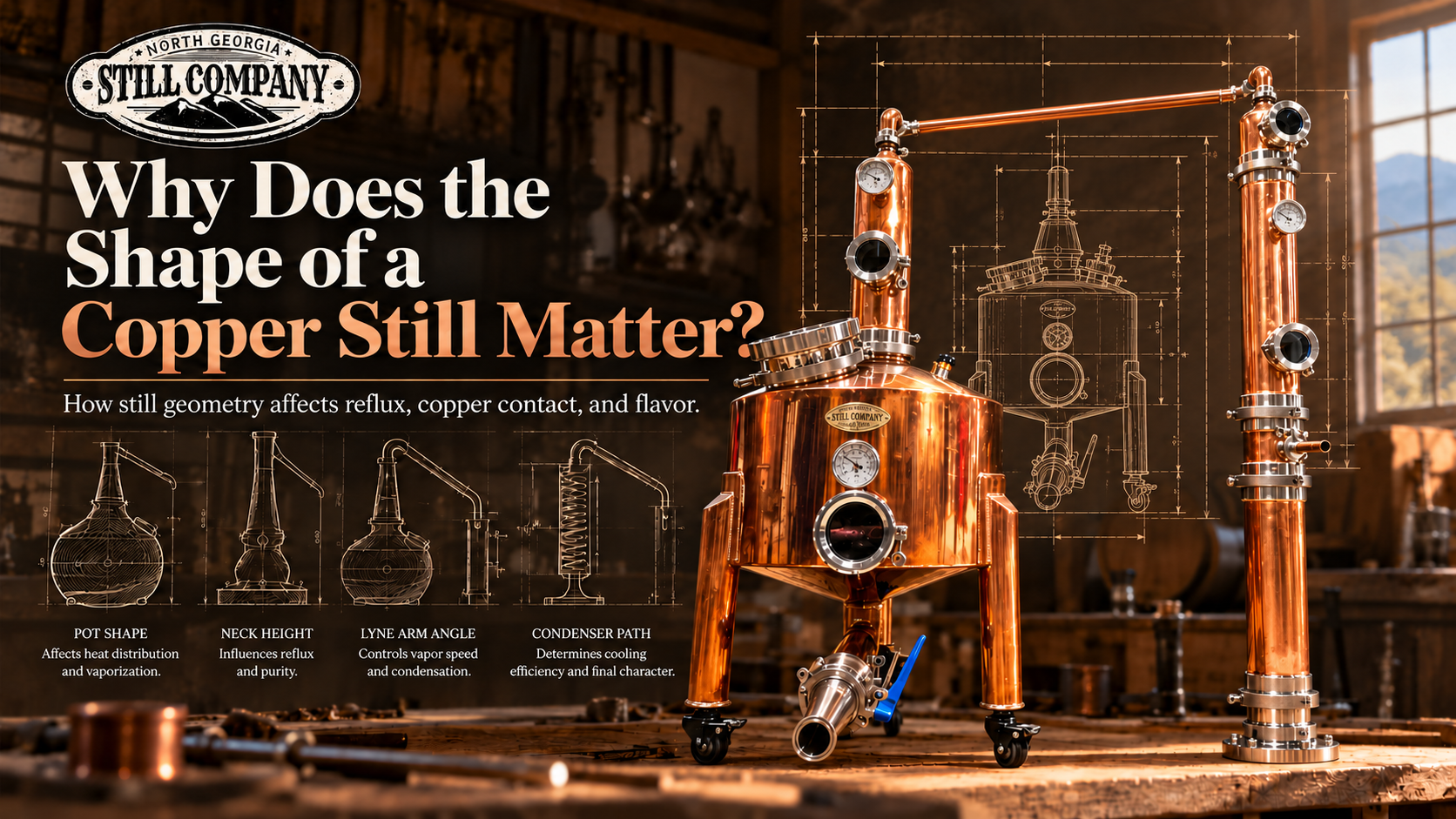
The shape of a copper still influences how vapor moves through the system, how much natural reflux occurs, how much contact the vapor has with copper, and ultimately the character of what comes out the other end.
That’s one of the things that makes traditional copper still building so interesting.
A still isn’t simply a container with a pipe attached to it.
The entire shape becomes part of the process.
It Starts with the Pot
Everything begins in the boiler.
As a fermented wash or mash is heated, volatile compounds begin entering the vapor phase. That vapor then has to make its way out of the pot and through the rest of the still.
The size and shape of the pot influence the space available above the liquid and how vapor enters the head and neck of the still.
A broad onion-shaped pot, a traditional round boiler, and a tall narrow vessel may all hold approximately the same amount of liquid—but that doesn’t mean vapor behaves the same way inside each one.
This is one reason traditional distilleries often become extremely attached to the dimensions of their stills.
When an old still eventually has to be replaced, many distilleries try to reproduce its shape as closely as possible because the geometry has become part of that distillery’s process and spirit character.
Neck Height Can Change the Journey
Once vapor leaves the main body of the still, it begins climbing through the head and neck.
This is where height becomes important.
Taller necks generally encourage more natural reflux.
As hot vapor rises through a tall copper neck, some of it cools enough to condense on the inside surface.
Instead of continuing toward the condenser, that liquid falls back down the still.
It heats up again.
Vaporizes again.
And begins climbing again.
That’s reflux.
Each time that happens, some additional separation can occur.
In general, a taller still with a longer vapor path tends to encourage more reflux and can favor a lighter, more refined spirit character. Shorter, squatter pot stills tend to provide less passive reflux and can allow more heavier, flavorful compounds to continue through the system.
That doesn’t mean tall is better.
And it doesn’t mean short is better.
It means they’re different.
What Is Reflux, and Why Does It Matter?
Reflux sounds complicated, but the basic idea is simple.
Imagine vapor climbing through the still.
Some makes it all the way to the condenser.
Some cools before it gets there, turns back into liquid, and runs back toward the boiler.
That liquid then gets another chance to vaporize.
More reflux generally means more repeated separation inside the still.
That’s one reason still shape can influence whether a spirit tends toward a lighter, cleaner profile or retains more of the heavier character produced during fermentation.
Reflux isn’t determined by just one thing, either.
Still height, neck diameter, head shape, vapor path, heat input and lyne-arm design can all play a role.
So when we design a still, we’re not looking at one isolated component.
We’re looking at the entire path the vapor has to travel.
The Shape of the Head Matters Too
That big onion, ball or bulge you see above the boiler on many traditional stills isn’t necessarily there just because someone thought it looked good.
Changes in diameter affect how vapor moves.
When vapor leaves a narrower area and enters a larger chamber, its behavior changes. The increased surface area can also create additional opportunities for vapor to contact copper and for some condensation to occur.
Then the vapor has to transition back into the narrower neck above it.
Different still makers have developed countless variations over the years:
Onion heads.
Boil balls.
Lantern shapes.
Straight heads.
Tapered heads.
Swan necks.
Some differences are rooted in tradition. Others are deliberate attempts to influence reflux and vapor behavior.
And some simply evolved because that’s the way a particular still maker built them.
But taken as a whole, the shape of the head becomes another part of the still’s personality.
Then There’s the Lyne Arm
After vapor makes it through the head and neck, it usually enters the lyne arm—the pipe carrying vapor from the still head toward the condenser.
It may look like nothing more than a pipe.
Its orientation can matter.
An upward-rising vapor path generally makes it harder for condensed liquid to continue toward the condenser. Some condensate can return toward the pot, contributing to reflux.
A downward-running path tends to make it easier for vapor and condensate to continue toward the condenser.
That means the angle, length and diameter of the lyne arm can all become part of the overall design.
Traditional distilleries use a huge variety of lyne-arm arrangements, and those differences are one more reason two copper pot stills can behave differently even when their boiler capacities are similar.
The Vapor Path Is Really What We’re Designing
This is probably the easiest way to understand still shape.
Instead of looking at the still from the outside, imagine you’re a molecule of vapor trying to travel through it.
Where do you go?
How high do you have to climb?
Does the chamber suddenly become wider?
Does it narrow again?
How much copper do you encounter?
How easily can condensed liquid fall back toward the boiler?
Does the lyne arm climb or descend?
How long is the journey before you finally reach the condenser?
When you start looking at a still that way, the strange curves begin making a lot more sense.
We’re really designing a vapor path.
The copper wrapped around that vapor path just happens to turn it into one of the most recognizable pieces of equipment in the distilling world.
Copper Contact Is Part of the Equation
Still geometry also affects how much opportunity vapor has to interact with copper.
That’s important because copper isn’t merely a traditional building material.
Copper participates in the distillation process and can interact with sulfur-containing compounds produced during fermentation. Research into distilled spirits has found that copper contact can influence sulfur chemistry and the resulting sensory character of the spirit.
That means the amount of copper isn’t the only consideration.
Where that copper is located and how vapor moves across it matters too.
A long copper vapor path creates different contact opportunities than a short one.
A large copper head creates different surface exposure than a straight pipe.
Additional reflux can cause vapor and condensate to interact with copper repeatedly before leaving the still.
Shape and material work together.
Don’t Forget the Condenser
Eventually, all that vapor has to become liquid again.
That’s the condenser’s job.
Once the vapor reaches the condenser, heat is removed until the vapor condenses back into liquid distillate.
Condenser design affects cooling efficiency and how the system is operated, so it has to be properly matched to the still and the amount of vapor being produced.
A beautiful pot and head don’t mean much if the condenser can’t adequately handle the vapor coming from them.
That’s why we look at the still as a complete system:
Boiler → Head → Neck → Lyne Arm → Condenser
Each component has a job.
And each affects the component after it.
Does a Unique Shape Automatically Make a Better Still?
No.
Different doesn’t automatically mean better.
There are plenty of extremely simple still designs that have been producing excellent spirits for generations.
The goal isn’t to make the vapor path as complicated as possible.
The goal is to build the still to accomplish what you want it to accomplish.
Sometimes simplicity is exactly right.
Other times, changing the neck height, head shape, vapor path or other components gives a still a completely different character.
That is where the craft gets interesting.
This Is Why We Love Building One-of-a-Kind Stills
At North Georgia Still Company, most of our everyday stills are based around proven traditional designs.
But our Special Projects Division gives us an opportunity to explore the other side of still making.
What happens when we change the shape?
What happens when we combine traditional copper still making with modern TIG fabrication?
What happens when we build something nobody expects a still to look like?
That’s part of the thinking behind Still #001, Still #002 and the Special Projects stills that will follow them.
The goal isn’t to make something strange simply for the sake of being different.
Each build gives us an opportunity to think about proportion, vapor path, copper contact, fabrication and function—and then wrap all of that into something visually unique.
Some of those designs may look dramatically different from a traditional pot still.
But underneath the copper, the same basic questions remain:
How will vapor move through it?
Where will reflux occur?
How much copper contact will it have?
How will it condense?
And what does every part of the design contribute?
That’s what makes building them fun.
There Is No One Perfect Still Shape
If there were one perfect copper still shape, every distillery in the world would probably be using it.
They aren’t.
Instead, the distilling world is filled with tall stills, short stills, fat stills, narrow stills, strange stills, beautiful stills and some designs that look like they were dreamed up after somebody spent way too much time staring at a sheet of copper.
We happen to like those.
Because distilling isn’t always about removing every variable.
Sometimes those differences are what create character.
And for a still maker, that’s where craftsmanship and engineering meet.
A copper still’s shape isn’t just what makes it recognizable.
It’s part of what makes that still what it is.
Always follow applicable federal, state, and local laws concerning the ownership and use of distilling equipment and the production of distilled spirits.